
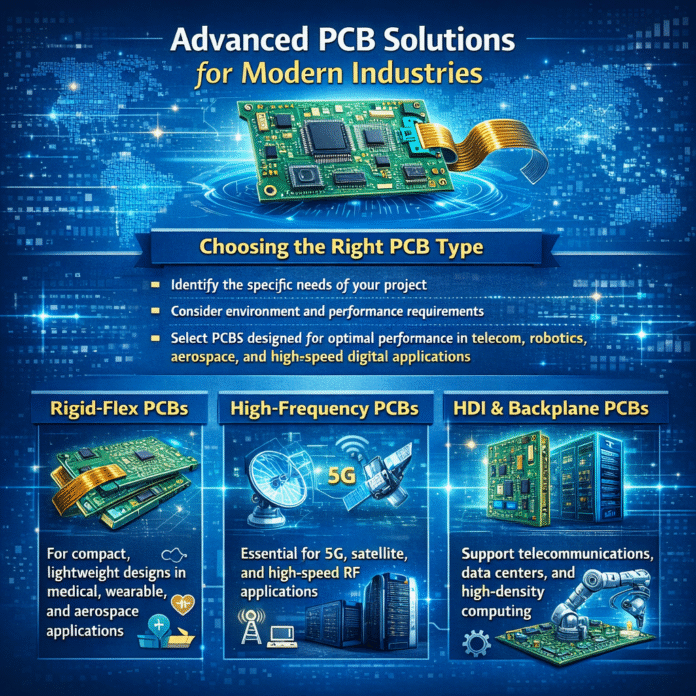

In an era defined by rapid technological advancement, the humble Printed Circuit Board (PCB) has evolved from a simple component into the sophisticated backbone of virtually every electronic device. As industries push the boundaries of innovation, the demands placed on PCB design, fabrication, and assembly have grown exponentially. From the miniaturization of consumer electronics to the robust requirements of aerospace systems, the quality and complexity of PCBs are paramount to product reliability and performance. This article delves into how cutting-edge PCB technologies are not just supporting, but actively driving, the transformative changes seen in sectors like telecommunications and robotics.
The journey from concept to a functional electronic device is intricate, requiring precision at every stage. The foundation of this process lies in expert PCB fabrication and meticulous assembly. As electronic systems become more compact and powerful, traditional rigid PCBs often face limitations in space and flexibility. This has spurred the development of advanced solutions that cater to these evolving needs. For companies seeking a partner with deep technical expertise in navigating these complexities, specializing in advanced PCB solutions, Global Well PCBA stands out as a key player in the manufacturing landscape, offering comprehensive services from design to final assembly.
The Shift Toward Rigid-Flex PCB Technology
The advent of Rigid-Flex PCB technology represents a significant leap forward in electronic packaging, effectively combining the best attributes of both rigid and flexible circuit boards. These hybrid boards consist of multiple layers of flexible circuit substrates attached to one or more rigid boards, offering a three-dimensional interconnect solution that traditional PCBs cannot match.
The primary advantage of Rigid-Flex PCBs lies in their ability to save space, reduce weight, and enhance reliability by minimizing or entirely eliminating the need for connectors and cables. In applications where space is at a premium, such as in compact medical devices, wearable technology, or advanced aerospace systems, Rigid-Flex designs allow for tighter packaging densities. The flexible sections can be bent or folded during assembly, enabling unique form factors and simplifying mechanical designs. This inherent flexibility also reduces the number of solder joints and board-to-board connectors, which are common points of failure in traditional electronic assemblies. By integrating multiple rigid boards into a single flexible circuit, the overall system becomes more robust and less susceptible to vibration and shock, leading to significantly improved product longevity and performance.
High-Frequency PCBs: Powering the 5G and Satellite Era
The relentless demand for faster data transmission and higher bandwidth, particularly with the rollout of 5G networks and the expansion of satellite communication, has propelled High-Frequency PCBs to the forefront of electronic design. These specialized PCBs are engineered to handle signals in the gigahertz range and beyond, where conventional FR-4 materials fall short.
Designing for high frequencies introduces a unique set of technical requirements, including stringent control over impedance, minimal signal loss, and careful management of electromagnetic interference (EMI). Signal integrity becomes paramount, as even minor imperfections in the PCB layout or material properties can lead to significant signal degradation. To meet these demands, manufacturers rely on specialized material considerations. Instead of standard FR-4, high-frequency PCBs often utilize advanced laminates such as those based on PTFE (Teflon), ceramic-filled hydrocarbons (like Rogers Corporation materials), or other low-loss dielectric materials. These materials exhibit stable dielectric constants and low dissipation factors across a wide range of frequencies, which are crucial for maintaining signal quality.
Challenges in design for high-frequency applications include meticulous routing to minimize trace length and avoid sharp bends, precise impedance matching to prevent reflections, and effective shielding to mitigate crosstalk and EMI. The PCB stack-up must be carefully planned to provide optimal signal paths and ground planes. The table below highlights key differences between standard FR4 and high-frequency materials:
| Feature | Standard FR4 | High-Frequency Materials (e.g., Rogers) |
| Dielectric Constant (Dk) | Varies with frequency, higher loss | Stable across frequencies, low loss |
| Dissipation Factor (Df) | Higher, leading to signal attenuation | Very low, minimizing signal loss |
| Frequency Range | Up to a few GHz (with limitations) | Tens of GHz and beyond |
| Cost | Lower | Higher |
| Applications | General purpose, low-frequency digital | RF, microwave, 5G, satellite, high-speed digital |
PCB Assembly (PCBA) Excellence for Robotics
Robotics, a field characterized by precision, mobility, and often harsh operating environments, places exceptionally high demands on PCB Assembly (PCBA). The electronic brains of robots must be compact, robust, and capable of flawless operation under dynamic conditions, from extreme temperatures to constant vibration.
The unique demands of robotics necessitate PCBA processes that prioritize durability, vibration resistance, and the ability to fit into highly constrained and often irregular form factors. Components must be securely mounted to withstand mechanical stress, and interconnections must be reliable to ensure uninterrupted data flow between sensors, actuators, and microcontrollers. The role of SMT (Surface Mount Technology) is particularly critical in robotics, allowing for the placement of tiny, high-density components on both sides of the PCB, thereby achieving significant miniaturization. THT (Through-Hole Technology) is still utilized for larger, heavier components that require greater mechanical strength, such as connectors or power components, ensuring a robust physical connection.
Precision in component placement is paramount, especially for sensitive sensors, microcontrollers, and communication modules that are integral to a robot’s functionality. Automated assembly lines, utilizing pick-and-place machines, ensure the accuracy and repeatability required for complex robotic systems. Furthermore, advanced inspection techniques, such as Automated Optical Inspection (AOI) and X-ray inspection, are employed to verify solder joint quality and component alignment, crucial for the long-term reliability of robotic PCBs.
As a compelling case study, consider how Rigid-Flex PCBs enable articulated robotic joints. The flexible sections of these boards can bend and twist with the robot’s movements, eliminating the need for bulky wiring harnesses that would otherwise restrict motion and be prone to wear and tear. This not only allows for more compact and agile robotic designs but also significantly enhances the reliability and lifespan of the robot by reducing mechanical stress on connections.
Telecommunications and the Need for Advanced PCB Solutions
The telecommunications industry is a prime example of a sector where advanced PCB solutions are not just beneficial, but absolutely essential. The infrastructure supporting modern communication, from cellular networks to data centers, relies on high-performance PCBs to handle massive data volumes at incredible speeds.
The deployment of 5G infrastructure has particularly driven innovation in PCB technology. Technologies like Massive MIMO (Multiple-Input, Multiple-Output) antennas, small cells, and high-density interconnects (HDI) require PCBs that can support complex signal routing, high component densities, and superior thermal management. HDI PCBs, with their finer lines, smaller vias, and higher routing capabilities, are critical for packing more functionality into smaller footprints, which is vital for compact 5G base stations and user equipment.
The role of multilayer and backplane PCBs is also crucial in telecommunication equipment, especially in server and storage systems that form the backbone of data networks. These PCBs can have dozens of layers, allowing for intricate signal routing and power distribution, while backplane PCBs provide the high-speed interconnects between various daughterboards, ensuring reliable data transfer within complex systems. Given the high power consumption and continuous operation of telecommunication hardware, thermal management strategies are paramount. This includes the use of specialized thermal materials, heat sinks, and efficient layout designs to dissipate heat effectively, preventing performance degradation and extending the lifespan of critical components.
Tips about Choosing a Turnkey PCB Manufacturer
For businesses and innovators, selecting the right PCB manufacturer is a strategic decision that can significantly impact product development timelines, costs, and overall quality. A turnkey PCB manufacturer offers a comprehensive, one-stop solution that streamlines the entire process from design to final product.
The primary benefits of one-stop solutions include simplified project management, reduced lead times, and cost efficiencies. Instead of coordinating with multiple vendors for design, component sourcing, fabrication, and assembly, a single turnkey provider manages the entire workflow. This integrated approach minimizes communication overhead, reduces the risk of errors, and accelerates time-to-market. A reputable turnkey manufacturer will have expertise in design for manufacturability (DFM) and design for assembly (DFA), ensuring that the PCB design is optimized for efficient and cost-effective production.
Quality assurance is another critical aspect. Look for manufacturers with industry-recognized certifications such as ISO 9001 for quality management and UL certifications for safety standards. Advanced inspection techniques like AOI (Automated Optical Inspection) are used to detect defects in solder joints and component placement, while X-ray testing can identify hidden flaws within multilayer boards or under BGA (Ball Grid Array) components. These rigorous inspection processes ensure that every PCB meets the highest quality standards.
Effective supply chain management is also a hallmark of a top-tier turnkey provider. This includes robust processes for sourcing original components from authorized distributors, thereby avoiding counterfeits and ensuring the authenticity and reliability of every part. A strong procurement team can navigate global supply chains, mitigate risks, and secure components at competitive prices, even during periods of shortage.
Future Trends in PCB Fabrication and Assembly
The PCB industry is dynamic, constantly evolving to meet the demands of emerging technologies. Several key trends are shaping the future of PCB fabrication and assembly, promising even more powerful, compact, and sustainable electronic solutions.
One significant trend is the rise of Ultra HDI (UHDI) and Substrate-Like PCBs (SLP). UHDI PCBs push the boundaries of miniaturization with even finer lines, smaller vias, and higher layer counts, enabling incredibly dense component packaging. SLPs, which bridge the gap between traditional PCBs and semiconductor packaging, offer even greater density and performance, becoming crucial for advanced smartphones, AI processors, and other high-performance computing applications.
Sustainable manufacturing is gaining increasing importance. This involves the adoption of eco-friendly materials, such as halogen-free laminates and lead-free solders, as well as processes that reduce waste, conserve energy, and minimize environmental impact. Manufacturers are investing in greener technologies and recycling programs to align with global sustainability goals.
Finally, the integration of AI and machine learning in PCB design and automated assembly lines is revolutionizing the manufacturing process. AI algorithms can optimize PCB layouts for performance, manufacturability, and cost, significantly reducing design cycles. In assembly, AI-powered vision systems enhance inspection accuracy, while machine learning can predict equipment failures and optimize production schedules, leading to greater efficiency and yield. These advancements are paving the way for fully autonomous PCB manufacturing facilities.
Conclusion
The continuous evolution of printed circuit board technology is fundamental to the progress of modern industries. From the space-saving ingenuity of Rigid-Flex PCBs to the high-speed capabilities of High-Frequency boards, these advanced solutions are indispensable for the next generation of telecommunications, robotics, and countless other electronic applications. The complexity of these technologies underscores the strategic importance of partnering with manufacturers who possess deep technical expertise and a commitment to quality.
For engineers and businesses navigating the intricate landscape of electronic design and manufacturing, choosing a reliable and experienced PCB and PCBA provider is paramount. Such a partnership ensures access to cutting-edge solutions, meticulous quality control, and efficient supply chain management, ultimately translating into superior product performance and faster time-to-market. To explore advanced PCB and PCBA solutions tailored to your specific project needs, consider visiting globalwellpcba.com.