
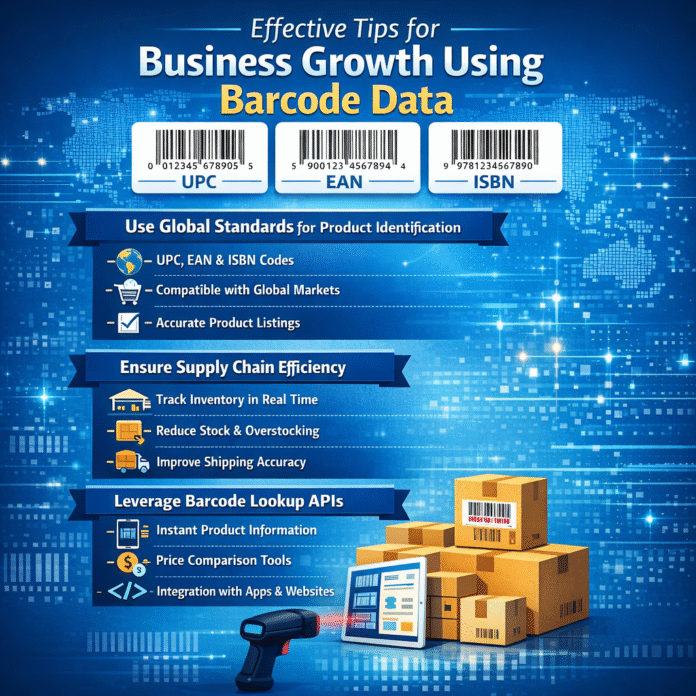

In the intricate tapestry of modern commerce, barcodes have emerged as indispensable tools, silently orchestrating the flow of products from manufacturing plants to consumer hands. These seemingly simple patterns of lines and numbers serve as critical bridges, connecting physical goods to a wealth of digital information. From tracking inventory in vast warehouses to facilitating swift transactions at retail checkouts, barcode data underpins the efficiency and accuracy of global supply chains. Understanding the fundamental role of Universal Product Codes (UPC), European Article Numbers (EAN), and International Standard Book Numbers (ISBN) is paramount for any business aiming to thrive in today’s interconnected marketplace.
The strategic utilization of barcode data extends far beyond mere product identification; it is a cornerstone of operational excellence and competitive advantage. By leveraging comprehensive barcode databases and advanced lookup services, businesses can gain unprecedented insights into their product ecosystems. This digital infrastructure empowers companies to streamline complex processes, enhance data accuracy, and ultimately drive growth. For developers and businesses seeking robust solutions for integrating barcode scanning and data retrieval into their applications, platforms like BarcodeReport offer essential tools and extensive databases to meet diverse needs.
The Role of Barcodes in Modern E-Commerce
The explosive growth of e-commerce has amplified the importance of barcodes, transforming them from simple identifiers into vital components of digital commerce infrastructure. In an environment where speed, accuracy, and real-time information are paramount, barcodes provide the backbone for efficient operations.
One of the most significant contributions of barcodes is their role in streamlining inventory management and supply chain logistics. Every product moving through a supply chain, from raw materials to finished goods, can be uniquely identified and tracked using its barcode. This allows businesses to monitor stock levels with precision, reduce instances of overstocking or understocking, and optimize warehouse layouts. When a product is scanned at various points—upon arrival at a distribution center, during picking and packing, and at shipment—its journey is meticulously recorded, providing a transparent and auditable trail. This level of detail is crucial for forecasting demand, managing returns, and ensuring that products reach their destinations efficiently.
Beyond internal operations, barcodes are instrumental in enhancing product visibility on global marketplaces. Platforms like Amazon, eBay, and Google Shopping rely heavily on standardized product identifiers like UPCs and EANs to categorize and display products accurately. When a product’s barcode data is consistent and readily available, it improves its discoverability in search results, builds consumer trust through verified product information, and facilitates seamless integration into various online retail ecosystems. Without these standardized codes, products would be difficult to list, compare, and sell across different online channels, hindering a business’s reach and sales potential.
Understanding Different Barcode Standards
While often used interchangeably, various barcode standards exist, each designed for specific applications and geographical regions. Understanding their distinctions is key to proper product identification and global market access.
UPC (Universal Product Code)
The Universal Product Code (UPC) is predominantly used in North America (the United States and Canada) for tracking trade items in stores. It is a 12-digit numeric code, typically represented by a barcode with vertical lines of varying widths. The UPC-A is the most common version, encoding a company prefix, item reference, and a check digit. Its primary function is to enable rapid scanning at points of sale, linking products to their prices and inventory data in a retailer’s system. The UPC system has been foundational in the development of self-service retail and efficient inventory management across the continent.
EAN (European Article Number)
The European Article Number (EAN), also known as International Article Number, is the global equivalent of the UPC, used primarily outside of North America. The most common EAN format is EAN-13, which consists of 13 digits. It includes a country code, manufacturer code, product code, and a check digit. EANs are fully compatible with UPC systems, meaning scanners can read both. This global standard facilitates international trade, allowing products to be identified and tracked seamlessly across borders, which is crucial for businesses operating in a globalized economy.
ISBN (International Standard Book Number)
The International Standard Book Number (ISBN) is a unique numeric commercial book identifier. It is a 13-digit number (since 2007; previously 10 digits) assigned to each edition and format of a book by publishers. ISBNs are specifically designed for books and related products (like audiobooks and e-books) to help publishers, booksellers, libraries, and readers locate and order publications. While it functions similarly to UPCs and EANs in terms of unique identification, its application is specialized for the publishing industry, allowing for precise tracking within the vast catalog of literary works.
Here’s a comparison of these primary barcode types:
| Barcode Type | Primary Region | Digits | Primary Use Case |
| UPC-A | North America | 12 | Retail products |
| EAN-13 | Global | 13 | Retail products, international trade |
| ISBN-13 | Global | 13 | Books and publications |
How to Leverage Barcode Lookup APIs for Developers
For developers, the ability to integrate barcode scanning and data retrieval into applications has opened up a new frontier of possibilities. Barcode Lookup APIs provide a programmatic interface to vast databases of product information, enabling the creation of powerful and efficient applications.
Integrating barcode scanning into mobile and web applications allows users to simply scan a product’s barcode with their device’s camera to instantly access detailed information. This functionality is invaluable for a wide range of applications, from personal inventory management apps to sophisticated retail solutions. Developers can build features that allow consumers to compare prices, read reviews, check nutritional information, or even track product origins with a quick scan.
The benefits of real-time data retrieval are immense. Instead of manually inputting product details, which is prone to errors and time-consuming, an API call can instantly fetch product names, descriptions, images, manufacturer details, and even pricing information from a centralized database. This capability is crucial for simplifying catalog building for e-commerce platforms and creating effective price comparison tools that empower consumers to make informed purchasing decisions.
From a technical considerations standpoint, most barcode APIs provide data in a JSON format, which is easily parsed and integrated into various programming languages and frameworks. Developers typically need an API key for authentication and to manage request limits, which vary depending on the service provider and subscription plan. Understanding the API documentation, including available endpoints and response structures, is essential for seamless integration and optimal performance. This allows for robust applications that can handle millions of barcode lookups daily, supporting everything from small independent apps to enterprise-level systems.
Benefits of a Comprehensive Barcode Database
A comprehensive barcode database is more than just a collection of numbers; it’s a powerful asset that drives efficiency, accuracy, and informed decision-making across various business functions.
One of the most immediate benefits is the ability to access millions of product records instantly. This vast repository of information eliminates the need for businesses to manually create and maintain their own product databases, saving significant time and resources. Whether it’s a small startup launching a new product line or a large retailer managing thousands of SKUs, a robust barcode database provides immediate access to standardized product data.
Furthermore, such databases are critical for ensuring data accuracy and reducing manual entry errors. Manual data input is inherently susceptible to human error, leading to discrepancies in inventory, incorrect pricing, and customer dissatisfaction. By relying on a verified, centralized barcode database, businesses can ensure that the product information they use is consistent and accurate, from the warehouse to the point of sale. This accuracy translates into better inventory control, fewer shipping mistakes, and improved customer service.
A comprehensive barcode database also plays a pivotal role in supporting both small businesses and large enterprises alike. Small businesses can leverage these resources to quickly get their products recognized and listed on major e-commerce platforms without the overhead of managing complex data standards. Large enterprises, on the other hand, benefit from the scalability and reliability of such databases for managing vast inventories, integrating with global supply chains, and performing large-scale data analysis. The ability to perform bulk lookup for large-scale inventory audits is particularly valuable, allowing companies to quickly reconcile physical stock with digital records, identify discrepancies, and maintain accurate financial reporting.
Tips about Optimizing Inventory with Barcode Scanning
Optimizing inventory management is a continuous process, and barcode scanning is a cornerstone of achieving peak efficiency. Implementing a well-designed barcode system can revolutionize how businesses track, store, and move their products.
Implementing a barcode-based tracking system in warehouses is a fundamental step. Each item, shelf, and location within a warehouse can be assigned a unique barcode. When items are received, moved, or shipped, scanning their barcodes updates their status in real-time. This eliminates the need for manual logbooks or spreadsheets, drastically reducing the time spent on inventory counts and improving the accuracy of stock levels. Forklift operators, pickers, and packers can use handheld scanners to confirm locations and quantities, ensuring that the right products are always in the right place.
This system significantly reduces human error in order fulfillment and shipping. When an order comes in, barcodes guide the picking process, ensuring that the correct items are selected. Before shipping, a final scan of all items in a package verifies that the order is complete and accurate, minimizing costly returns and customer complaints. This precision is vital for maintaining customer satisfaction and building a reputation for reliability.
Finally, barcode scanning enables real-time stock updates and automated reordering. As products are sold or moved, the inventory system is immediately updated. This real-time visibility allows businesses to set up automated reorder points, triggering new purchase orders when stock falls below a certain threshold. This proactive approach prevents stockouts, ensures continuous product availability, and optimizes cash flow by reducing excess inventory holding costs. The data collected through barcode scanning also provides valuable insights into sales trends, helping businesses make more informed purchasing and marketing decisions.
Future Trends in Barcode Technology
The evolution of barcode technology is continuous, with innovations promising even greater efficiency, data richness, and consumer engagement. The future of barcodes is moving beyond simple linear codes to more dynamic and interactive formats.
One significant trend is the transition from 1D to 2D barcodes, most notably QR codes and the emerging GS1 Digital Link. While traditional 1D barcodes (like UPC and EAN) store a limited amount of information, 2D barcodes can hold significantly more data, including URLs, product specifications, and multimedia content. This expanded capacity allows for richer consumer experiences and more detailed product information at the point of scan.
The GS1 Digital Link is a particularly exciting development. It’s a global standard that uses QR codes or other 2D barcodes to connect consumers and businesses to a wealth of online information about a product. By scanning a single code, users can access everything from product websites and social media channels to recall information, sustainability data, and instructional videos. This enhances traceability and consumer engagement, providing unprecedented transparency and fostering a deeper connection between brands and their customers.
Furthermore, the role of AI and machine learning in barcode data analysis is rapidly expanding. AI-powered systems can analyze vast amounts of barcode scan data to identify patterns, predict consumer behavior, optimize inventory levels, and even detect counterfeit products. Machine learning algorithms can improve the accuracy of barcode recognition, especially in challenging scanning environments, and provide predictive analytics for supply chain optimization. These advancements promise to make barcode data even more intelligent and actionable, driving further efficiencies and innovations across industries.
Conclusion
In an increasingly digital and interconnected world, the strategic importance of barcode data for business growth cannot be overstated. From the foundational role of UPC and EAN codes in global commerce to the advanced capabilities offered by barcode lookup APIs, these tools are essential for modern enterprises. They empower businesses to streamline inventory, enhance product visibility, reduce errors, and gain critical insights into their operations.
By embracing robust barcode solutions, companies can optimize their supply chains, improve customer satisfaction, and unlock new avenues for efficiency and innovation. The continuous evolution of barcode technology, with the rise of 2D codes and AI-driven analytics, promises an even more dynamic future for product identification and data management. For businesses looking to harness the full potential of barcode data and integrate powerful lookup capabilities into their systems, exploring resources like barcodereport.com is a crucial step towards achieving operational excellence and sustained growth.